


You are scrolling through a text or a DM and someone drops a quick “hru” with no other context. No punctuation, no capital letters, just three lowercase letters sitting there waiting for a reply. If you paused for even a second wondering what it meant or how to answer it, you are not alone. This little abbreviation shows up everywhere, from group chats to Instagram comments, and it trips up a lot of people who are not used to reading internet shorthand.
This guide breaks down exactly what HRU means, where it came from, how people use it today, and how you should respond depending on who sent it. By the end, you will be able to read and use HRU as naturally as anyone who grew up texting.
What Does HRU Mean in Text?
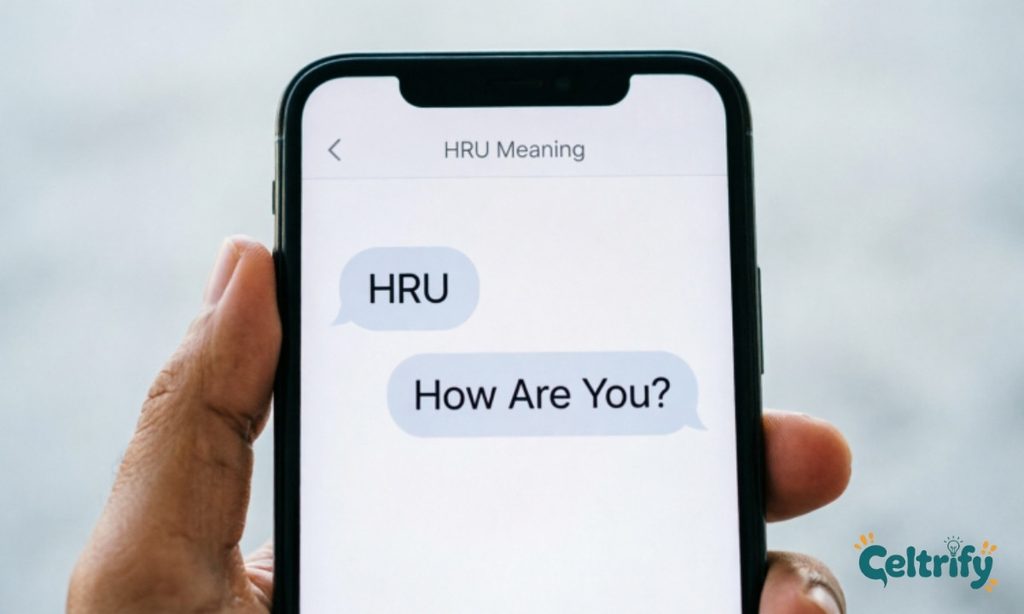
HRU stands for “How Are You?” It is a texting abbreviation formed from the first letters of “how,” “are,” and “you,” using the phonetic sound of the letters R and U. People use it as a quick, casual way to check in on someone in a text, DM, or social media comment.
That is the short version. Now let’s look at where it came from, how to use it properly, and how to reply when someone sends it to you.
Where Did HRU Come From?
HRU is not a new invention. It belongs to a family of texting shortcuts that grew out of early SMS culture, back when phones had limited character counts and typing on a numeric keypad was slow and clunky. People needed a fast way to greet each other without burning through their character limit, so common phrases got squeezed down to their essential letters.
“How are you” turned into “hru” the same way “be right back” turned into “brb” and “talk to you later” became “ttyl.” The letters R and U stuck around because they sound exactly like the words “are” and “you” when spoken out loud, which made them easy to remember and even easier to type.
Once smartphones and messaging apps took over, the character limit problem mostly disappeared. But the habit stayed. HRU had already become a normal part of how people greeted each other online, so it carried over into WhatsApp, Instagram, Snapchat, TikTok, and Discord, where it still lives today.
Read More : NSFW Meaning in Text
Why People Still Use HRU in 2026
You might wonder why anyone still shortens a five word question when typing is faster than ever and most keyboards offer autocomplete. There are a few real reasons this slang has held on.
- Speed and habit. Typing “hru” takes a second, and for many people it is now automatic muscle memory rather than a conscious shortcut.
- Tone. HRU feels light and low pressure. It does not carry the formality of “How are you doing today?” which can feel stiff in a casual chat.
- Conversation starter. It is an easy way to open a chat or check in without overthinking what to say.
- Group identity. Using slang like HRU signals that you are part of the same casual, digital-first communication style as the person you are texting.
- Cross-platform consistency. Since the same abbreviation works on every app, people do not need to adjust their texting style depending on where they are chatting.
How to Use HRU on Different Platforms
HRU shows up slightly differently depending on where it is used. Here is a quick breakdown of the most common places you will see it and how it tends to be used there.
| Platform | Common Use of HRU | Typical Tone |
| Text messages (SMS) | Opening line to a friend or family member | Casual, friendly |
| Daily check-ins with contacts or group chats | Warm, familiar | |
| Instagram DMs and comments | Quick reply to a story or post | Light, social |
| Snapchat | Fast back and forth chats | Very casual |
| TikTok comments | Reaction or reply to a creator or friend | Playful |
| Discord and gaming chats | Checking on teammates before or after a match | Friendly, informal |
Across all of these, the meaning stays the same. What changes is the tone and how much effort people put into the reply.
HRU Examples in Real Conversations

Seeing HRU in context makes it much easier to understand naturally. Here are a few realistic examples.
Example 1 Person A: hey! hru? Person B: doing good, just got back from work. hru?
Example 2 Person A: hru today, feeling any better? Person B: yeah a bit, thanks for checking in
Example 3 Person A: omg it’s been forever, hru?? Person B: honestly been super busy lol, hru though
Example 4 (Instagram comment) Comment: “loved this post! hru these days”
In each case, HRU is doing the same job: opening the door for a short, friendly exchange without sounding overly formal.
Read slang : BFFR Meaning in Text
How to Reply to HRU
There is no single correct answer to HRU, but your reply usually falls into one of a few categories depending on your mood and how much detail you want to share.
| Reply Style | Example Response | Best Used When |
| Short and simple | “good, hru” | Casual chat, no need for detail |
| Positive and upbeat | “great actually! how about you” | You want to keep the energy light |
| Honest and detailed | “been a bit stressed with work tbh” | You feel comfortable sharing more |
| Neutral | “same as usual” | Nothing much has changed |
| Redirect | “good! anyway did you see…” | You want to move the conversation forward |
A good rule of thumb is to answer briefly, then throw the question back with “hru” or “how about you” so the conversation keeps flowing naturally.
Other Meanings of HRU
While “How Are You” is by far the most common meaning, context matters. In rare cases, HRU can carry a different meaning outside of casual texting.
| Meaning | Context |
| How Are You | Standard texting and chat use, over 95 percent of cases |
| Human Resource Unit | Occasionally used in business or organizational contexts |
| Hawaii Rainbow Warriors | Used in sports contexts referring to the University of Hawaii |
| Typo for “hr u” or “her/you” | Rare autocorrect or typing mistake |
If someone sends you “HRU” in a normal chat, it is safe to assume it means “How Are You” unless the surrounding conversation clearly points somewhere else.
Common Mistakes People Make With HRU
A few misunderstandings pop up again and again when people first encounter this abbreviation.
- Assuming it is rude. A short “hru” can feel abrupt if you are not used to text slang, but it is almost never meant that way. It is simply efficient texting, not a lack of interest.
- Confusing it with similar letters. “HRU” can occasionally get mixed up with “HR” or misread if typed quickly, especially on small keyboards.
- Reading too much into the tone. Without an emoji or extra words, HRU can feel cold even when the sender is being perfectly friendly. Tone in text is hard to judge from three letters alone.
- Using it in the wrong setting. HRU is built for casual chats. Using it in a work email or a formal message can come across as unprofessional.
When You Should Avoid Using HRU
HRU works well in casual, everyday conversations, but there are situations where it is better to spell things out.
- Professional communication. Work emails, official messages, and formal meetings call for the full phrase “How are you?”
- First impressions with strangers. If you are messaging someone you do not know well, especially in a professional or semi-formal setting, slang can feel too casual too fast.
- Serious or sensitive conversations. If someone just shared bad news or is going through something difficult, a full “How are you feeling?” shows more care than a quick “hru.”
- Cross-cultural or older audiences. Not everyone recognizes internet slang, especially people who are less active on social platforms or from different age groups and regions.
HRU vs Similar Texting Slang
HRU is part of a bigger family of texting shortcuts. Knowing how it compares to similar terms helps you use the right one in the right moment.
| Abbreviation | Full Meaning | Typical Use |
| HRU | How are you | Checking in on someone’s wellbeing |
| HBU | How about you | Turning a question back after answering it |
| WYD | What you doing | Asking about someone’s current activity |
| SUP | What’s up | Casual greeting, less focused on wellbeing |
| WBU | What about you | Similar to HBU, redirecting a question |
| YH | Yeah | Quick agreement, not a greeting |
HRU and HBU are often used together in the same conversation, since one starts the check-in and the other passes the question back.
Fresh 2026 Update: How Texting Habits Around HRU Are Shifting
Text slang keeps evolving, and a few real shifts are worth knowing about heading into 2026.
Voice-to-text is changing how HRU appears. As more people dictate messages instead of typing them, phones often autocorrect spoken phrases like “how are you” into full words rather than abbreviations. This means HRU shows up more often in fast, thumb-typed messages than in voice-dictated ones, and its use is becoming slightly more generational, with younger texters typing it out of habit and older users typing the full phrase because that is what their voice assistant produces.
AI chat assistants rarely use it. As more everyday conversations now involve chatting with AI tools alongside friends, people have started noticing that AI responses tend to use full, proper phrasing rather than texting shorthand. This has made HRU feel even more like a distinctly human, peer-to-peer signal. Seeing “hru” in a message is now almost a small marker that you are talking to a real person in a relaxed setting, not a formal system or a bot.
Emoji pairing has become the norm. Sending a bare “hru” with no emoji or punctuation is increasingly read as neutral to slightly flat, especially among younger texters. Pairing it with a simple emoji, like a smiley or heart, has become the expected way to soften the tone and make sure the question reads as warm rather than distant.
It has spread beyond English-first chats. HRU is now commonly mixed into multilingual texting, where people switch between their native language and English slang in the same message. It has become one of a small handful of English abbreviations that gets borrowed into casual chats worldwide, alongside terms like “lol” and “omg.”
Frequently Asked Questions
Is HRU rude to send?
No. HRU is not rude on its own. It is a standard, friendly way to check in on someone in a casual chat. It can feel abrupt without an emoji or extra warmth, but the abbreviation itself carries no negative meaning.
What does HRU mean from a girl?
From a girl or anyone else, HRU simply means “How are you?” The meaning does not change based on gender. Tone depends entirely on the context of the conversation, not on who sent it.
What does HRU mean from a guy?
Just like above, HRU from a guy means “How are you?” If it feels flirty or meaningful, that comes from the surrounding conversation, emojis, or your existing relationship, not from the abbreviation itself.
Is HRU flirty?
HRU is not inherently flirty. It is a neutral, casual greeting. It can feel flirty depending on who sends it, when, and what other messages surround it, but on its own it is simply a friendly check-in.
What is the full form of HRU?
The full form of HRU is “How Are You?” It is formed from the initial letters of “how” plus the phonetic sounds of “R” for “are” and “U” for “you.”
Can HRU be used in professional chats?
It is best to avoid HRU in professional emails, official messages, or formal workplace conversations. Spelling out “How are you?” reads as more polished and appropriate in those settings.
Conclusion
HRU is simply a fast, casual way of asking “How are you?” It started as a shortcut for slow typing and has stuck around because it is quick, friendly, and easy to use across every messaging platform.
Knowing when to use it, how to reply, and when to switch to the full phrase instead will help you sound natural in any conversation, whether you are texting a close friend or writing a professional email. Now that you know the meaning, origin, and proper context, you can read and reply to HRU with total confidence.

John David is a Passionate content creator and digital publisher behind Celtrify.com, dedicated to sharing helpful insights, trending topics, and quality online resources. Focused on delivering engaging, informative, and user-friendly content for readers worldwide.
